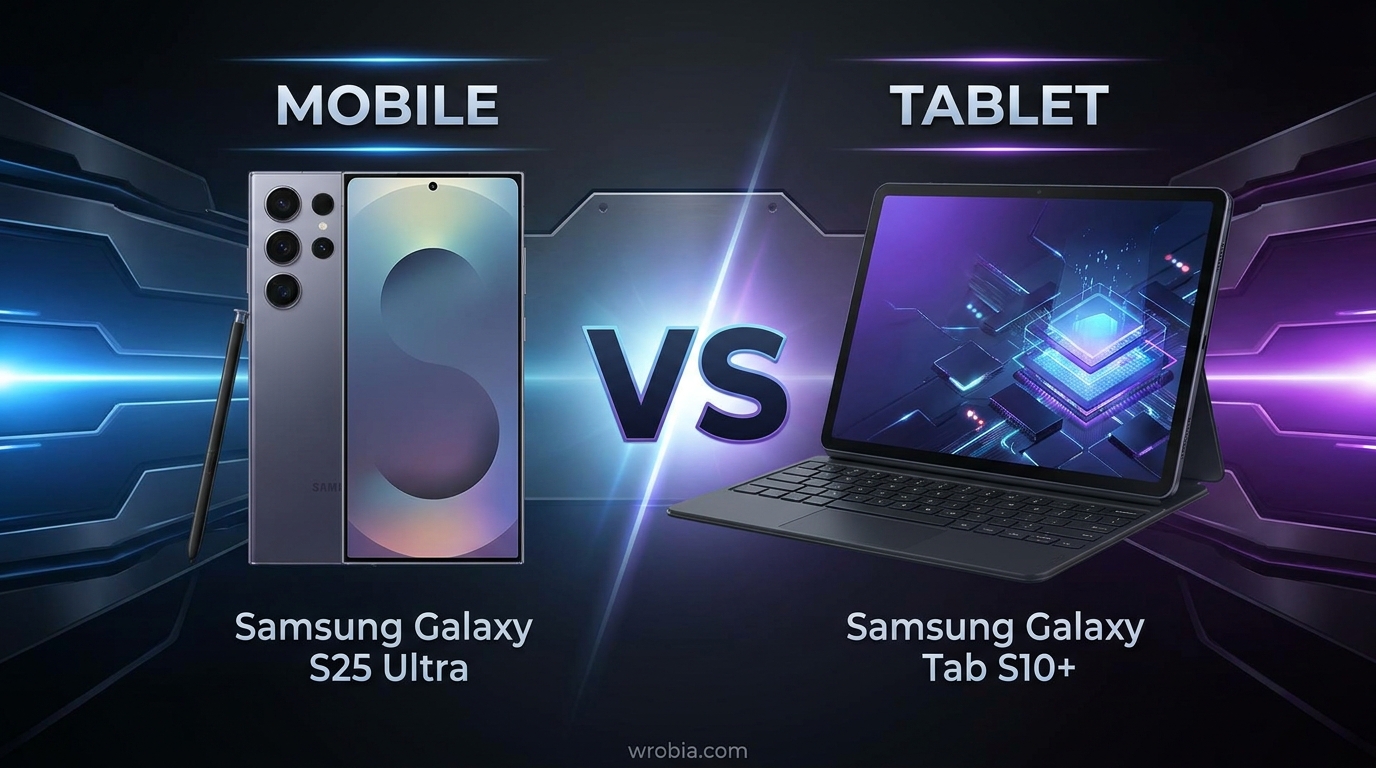
Introduction
Samsung’s product lineup covers nearly every form factor, and two of its most capable 2024-2025 devices are the Galaxy S25 Ultra and the Galaxy Tab S10+. On paper, comparing a flagship phone to a premium tablet might seem like an odd exercise — they serve different purposes. But for anyone trying to decide whether they need both, or whether one alone can cover their phone, tablet, and productivity needs (especially with S Pen support on each), a side-by-side look is genuinely useful. This article breaks down how these two devices stack up across design, performance, cameras, productivity, gaming, and value, so you can decide which one — or whether both — deserves a spot in your bag.
Samsung Galaxy S25 Ultra vs Samsung Galaxy Tab S10+: Quick Comparison
| Spec | Galaxy S25 Ultra | Galaxy Tab S10+ |
|---|---|---|
| Display | 6.9″ QHD+ Dynamic AMOLED 2X, 120Hz | 12.4″ Dynamic AMOLED 2X, 120Hz, 2800×1752 |
| Processor | Snapdragon 8 Elite for Galaxy | MediaTek Dimensity 9300+ |
| RAM | 12GB / 16GB | 12GB |
| Storage | 256GB / 512GB / 1TB | 256GB / 512GB |
| Rear Cameras | 200MP wide + 50MP ultra-wide + 50MP periscope telephoto + 10MP telephoto | 13MP wide + 8MP ultra-wide |
| Battery | 5000 mAh, 45W wired | 10,090 mAh, 45W wired |
| Build | Titanium frame, Gorilla Armor 2, IP68 | Armor Aluminum frame, IP68 |
| S Pen | Built-in, stored in body | Included, magnetic attach |
| OS | Android 15, One UI 7 | Android 14/15, One UI |
| Starting Price | ~$1,299 | ~$999 |
Design and Build Quality
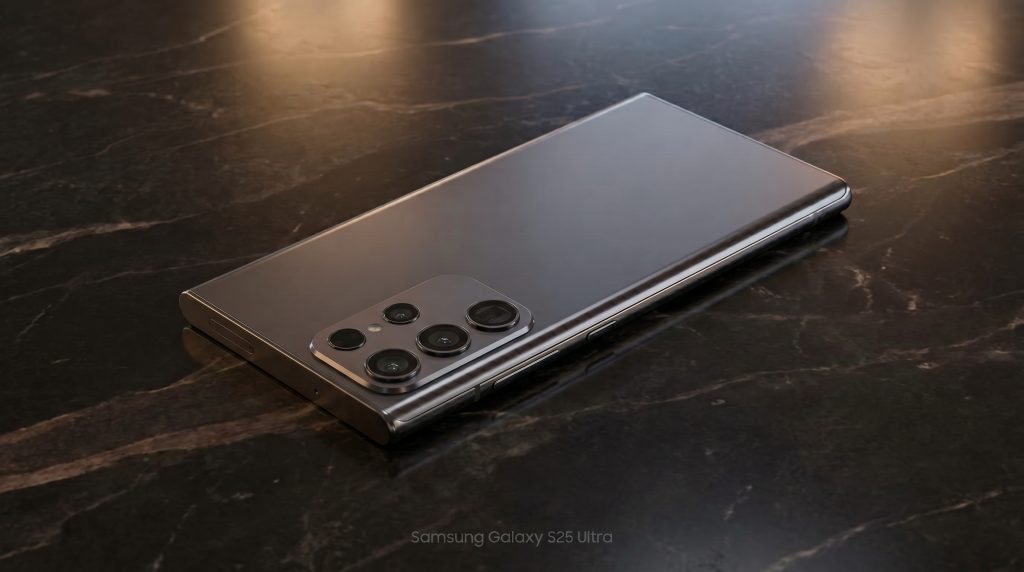
The Galaxy S25 Ultra carries over Samsung’s titanium frame from its predecessor, now paired with Corning Gorilla Armor 2 on both front and back, which Samsung says offers enhanced durability with over four times greater scratch resistance than competing aluminosilicate glass. The phone uses rounded corners that align more closely with the rest of the Galaxy S line, a shift from the squared-off look of the S24 Ultra, and it comes in four standard titanium finishes plus two web-exclusive colors.
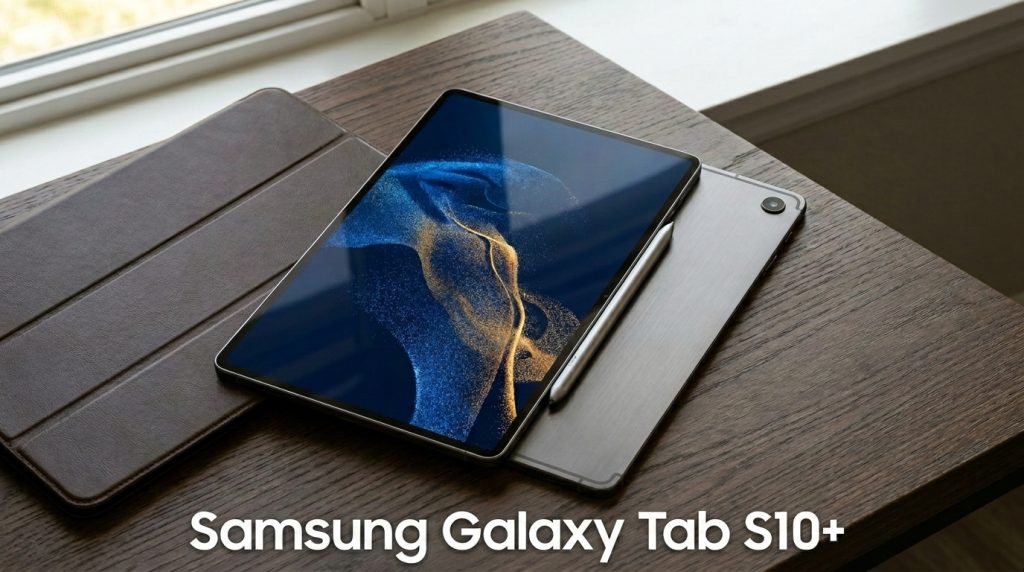
The Tab S10+ takes a different but equally premium approach. It uses a metal unibody with an Armor Aluminum frame, a glass front, and is rated IP68 for water and dust resistance — a rarity among Android tablets. It weighs in at roughly 571g for the Wi-Fi model and measures just 5.6mm thick, making it comfortable to hold for extended reading or note-taking sessions. Where the S25 Ultra is built to survive pocket life and drops, the Tab S10+ is built to feel substantial yet portable across a 12.4-inch footprint — both devices share the same IP68 rating, but the phone is clearly the more pocketable, rugged-feeling option of the two.
Display Comparison
The S25 Ultra’s 6.9-inch Dynamic AMOLED 2X panel is one of the sharpest and brightest screens on any phone, hitting up to 2600 nits peak brightness with a 120Hz adaptive refresh rate and HDR10+ support — ideal for outdoor visibility and HDR video.
The Tab S10+ counters with sheer real estate: a 12.4-inch Dynamic AMOLED 2X display at 2800×1752 resolution, also running 120Hz with HDR10+. Reviewers have measured excellent color accuracy on the panel, with 120% sRGB coverage and a Delta E under 2.0. For watching movies, marking up documents, or splitting the screen between apps, the Tab S10+’s display is simply more immersive — but the S25 Ultra’s panel gets noticeably brighter and is easier to use one-handed.
Performance and Processor
This is where the gap is widest. The S25 Ultra runs on the Snapdragon 8 Elite for Galaxy, a custom-tuned flagship chipset built for top-tier gaming, AI processing, and sustained performance.
The Tab S10+ uses a MediaTek Dimensity 9300+, Samsung’s first flagship tablet chip not sourced from Qualcomm. It’s a capable 4nm chipset that benchmarks close to a Snapdragon 8 Gen 3, and testers have recorded sustained 60fps gameplay in titles like Genshin Impact with minimal thermal throttling after 30 minutes. It’s strong for a tablet, but it doesn’t match the raw horsepower or AI acceleration of the Snapdragon 8 Elite inside the S25 Ultra.
RAM and Storage Options
The S25 Ultra offers more flexibility at the top end, with configurations of 12GB RAM paired with 256GB storage, scaling up to 16GB RAM with 1TB of storage for the highest tier. The Tab S10+ keeps things simpler: 12GB of RAM across the board, with storage choices of 256GB or 512GB, plus a microSD card slot for expansion — something the S25 Ultra lacks entirely. If you need maximum local storage and don’t want to rely on a memory card, the S25 Ultra’s 1TB option is unmatched here; if expandable storage matters more, the Tab S10+ has the edge.
Camera Comparison
There’s no real contest here. The S25 Ultra has a quad-camera system led by a 200MP main sensor, plus a 50MP ultra-wide, a 50MP periscope telephoto, and a 10MP telephoto lens, giving it versatile zoom range, strong low-light performance, and 8K video recording.
The Tab S10+ has a far more modest dual-camera setup — a 13MP wide and an 8MP ultra-wide — adequate for document scanning, video calls, or casual shots, but not built for serious photography. Tablet cameras are rarely a priority, and Samsung treats this one accordingly.
Battery Life and Charging
The Tab S10+ has the bigger battery by capacity, at 10,090 mAh versus the S25 Ultra’s 5000 mAh, but that capacity is spread across a much larger, more power-hungry display. In real-world testing, the Tab S10+ returned a video playback runtime of around 11 hours, while one benchmark test clocked a more workload-intensive runtime of just over 8 hours. The S25 Ultra, by comparison, is built for all-day phone use with typical mixed usage easily lasting a full day.
Charging speeds are similar on paper — both support 45W wired charging — though the Tab S10+’s larger cell means a full charge takes longer, with testers recording roughly 1 hour 30 minutes using an optional 45W adapter. The S25 Ultra also adds 15W wireless charging and reverse wireless charging, features the tablet doesn’t offer.
Software and User Experience
Both devices run Samsung’s One UI on top of Android, giving them a consistent look and feel, synced notifications, and shared Galaxy AI features like Circle to Search, Note Assist, and Sketch to Image. The S25 Ultra ships with Android 15 and the newer One UI 7, including AI-driven features like Now Brief and deeper Google Gemini integration baked into the side-button shortcut.
The Tab S10+ launched on Android 14 with One UI 6.1, with updates rolling out over time. The experience feels similar across both devices thanks to Samsung’s unified ecosystem, but the phone tends to receive feature updates first, with the tablet following later in the rollout cycle.
Productivity Features
This is arguably the Tab S10+’s strongest case for existing alongside the S25 Ultra. Its larger screen, included S Pen, and support for a detachable keyboard case make it a far more capable tool for note-taking, document editing, and multitasking via Samsung DeX. The pro camera system on the Tab S10 series keeps users in frame during video calls, which is useful for remote work.
The S25 Ultra also includes a built-in S Pen stored in the chassis, plus support for Samsung DeX and Wireless DeX for a desktop-like experience when connected to a monitor. But its smaller screen limits how comfortable extended writing, sketching, or spreadsheet work can be compared to the tablet. For heavy productivity use, the Tab S10+ is the better daily tool; the S25 Ultra is the better “always in your pocket” backup.
Gaming Performance
The Snapdragon 8 Elite in the S25 Ultra is one of the most powerful mobile gaming chipsets available, handling demanding titles at high settings with strong sustained performance and minimal throttling, backed by an efficient cooling design.
The Tab S10+’s Dimensity 9300+ is no slouch either, delivering smooth 60fps gameplay in graphically intensive titles, and the larger screen makes for a more immersive gaming experience overall. That said, the S25 Ultra generally posts higher benchmark scores and handles peak loads with less thermal throttling, giving it the edge in raw gaming performance, while the tablet wins on screen size and comfort for longer sessions.
Multimedia and Entertainment
For watching movies, streaming, or browsing, the Tab S10+’s 12.4-inch HDR10+ display with quad speakers creates a far more cinematic experience than any phone screen can match. It’s the better device for binge-watching, reading, or browsing the web comfortably.
The S25 Ultra’s display is sharper in pixel density and gets significantly brighter for outdoor use, plus it’s far more portable for on-the-go entertainment. Both support HDR10+ playback, but screen size ultimately decides this category — the tablet wins for immersive viewing, the phone wins for portability.
Connectivity and Accessories
Both devices support Wi-Fi 6E, Bluetooth 5.4, and optional 5G variants. The S25 Ultra includes USB Type-C 3.2 with DisplayPort 1.2 support, UWB, and an under-display ultrasonic fingerprint sensor. The Tab S10+ also includes an under-display fingerprint reader, a USB-C port that doubles as a video output, and — notably — a microSD card slot for expandable storage, something Samsung dropped from its phone lineup years ago.
Accessory ecosystems differ too: the S25 Ultra’s S Pen is built-in and requires no separate purchase, while the Tab S10+’s S Pen attaches magnetically to the back for charging and pairing. The tablet also supports Samsung’s detachable keyboard cases, turning it into a quasi-laptop, an option that doesn’t exist for the phone.
Price and Value for Money
The Galaxy S25 Ultra starts around $1,299 for the base 256GB configuration and climbs toward $1,659 or more for the 1TB, 16GB RAM model. The Tab S10+ starts lower, around $999 for the 256GB Wi-Fi model, though reviewers have noted that figure can feel steep compared to rival Android tablets, especially when keyboard and S Pen accessories are factored in for some configurations.
Given that the phone replaces a device you’d need regardless (a smartphone), while the tablet is more of an added convenience, the S25 Ultra arguably delivers more essential value per dollar — but the Tab S10+ undercuts the phone’s price for buyers who specifically want a large-screen companion device for work or media.
Pros and Cons
Galaxy S25 Ultra
Pros: class-leading camera system, top-tier Snapdragon 8 Elite performance, all-day battery in a compact body, built-in S Pen, sharper and brighter display, wireless charging.
Cons: smaller screen limits productivity and media comfort, premium pricing, no expandable storage.
Galaxy Tab S10+
Pros: large, vivid 120Hz display ideal for productivity and media, expandable storage via microSD, included S Pen, IP68 rating rare for tablets, strong multitasking with DeX and keyboard support.
Cons: modest camera system, shorter real-world battery runtime than its capacity suggests, no wireless charging, slower software update cadence.
Which One Should You Buy?
If you need one device that does everything — calls, photography, navigation, and productivity on the go — the Galaxy S25 Ultra is the clear choice. It’s a phone first, but a remarkably capable all-rounder thanks to its S Pen and DeX support.
If you already have a solid phone and want a dedicated device for note-taking, reading, streaming, or light creative work with a much bigger canvas, the Galaxy Tab S10+ fills that gap well, especially when paired with a keyboard case. Many users in Samsung’s ecosystem ultimately benefit from owning both, since they sync seamlessly and complement rather than duplicate each other’s strengths.
Frequently Asked Questions (FAQ)
Can the Galaxy Tab S10+ replace my phone? No — it has no cellular calling on Wi-Fi models, and even 5G variants are designed as a companion device, not a primary phone.
Is the S Pen the same on both devices? Functionally similar, but the S25 Ultra’s S Pen is built into the phone’s chassis, while the Tab S10+’s S Pen attaches magnetically to the back and needs to be paired separately.
Which has better battery life in practice? Despite its much larger battery, the Tab S10+’s big, power-hungry screen means its real-world runtime per charge isn’t dramatically longer than the S25 Ultra’s, and in some demanding benchmarks it’s shorter.
Does the Tab S10+ support 5G? Yes, a 5G variant exists alongside the Wi-Fi-only model, though availability varies by region.
Which is better for gaming? The S25 Ultra has the more powerful chipset and posts higher benchmarks, but the Tab S10+’s larger screen offers a more immersive experience for casual and competitive gaming alike.
Final Verdict
The Galaxy S25 Ultra and Galaxy Tab S10+ aren’t really competitors — they’re built for different jobs that happen to overlap in software and accessories. The S25 Ultra is the better choice for most people because it’s an essential, do-everything device with the strongest camera and processor Samsung currently offers. The Tab S10+ is the better choice for anyone who spends serious time on productivity, content consumption, or note-taking and wants a larger screen to do it on. If your budget and bag space allow for both, Samsung’s ecosystem makes them work together better than most cross-device pairings on the market.