Introduction
Comparing the Motorola Edge 60 Pro to the iPhone 14 Pro isn’t a typical head-to-head between two current flagships — it’s a comparison between two very different value propositions. The Edge 60 Pro is a 2025 mid-range-to-upper-mid-range Android phone still sold new, while the iPhone 14 Pro is a 2022 flagship that Apple has discontinued and that now lives mostly in the refurbished and renewed market. In 2026, that gap in age and positioning matters more than raw spec sheets. This guide breaks down how each phone actually performs today, and who each one makes sense for.
Motorola Edge 60 Pro vs iPhone 14 Pro: Quick Comparison
| Spec | Motorola Edge 60 Pro | iPhone 14 Pro |
|---|---|---|
| Release date | April 2025 | September 2022 (discontinued) |
| Display | 6.7″ P-OLED, 120Hz, up to 4500 nits peak | 6.1″ OLED, 120Hz ProMotion, up to 2000 nits peak |
| Chipset | MediaTek Dimensity 8350 Extreme (4nm) | Apple A16 Bionic (4nm) |
| RAM | 8GB / 12GB | 6GB |
| Storage | 256GB / 512GB | 128GB / 256GB / 512GB / 1TB |
| Rear cameras | 50MP main + 50MP ultrawide + 10MP telephoto (3x) | 48MP main + 12MP ultrawide + 12MP telephoto (3x) |
| Battery | 6000mAh, 90W wired | ~3200mAh, 20-27W wired |
| Charging port | USB-C | Lightning |
| OS | Android 15 (near-stock) | iOS 16, upgradable to iOS 19 |
| Current price | Roughly $389–$550 new | Roughly $300–$500 refurbished |
Design and Build Quality
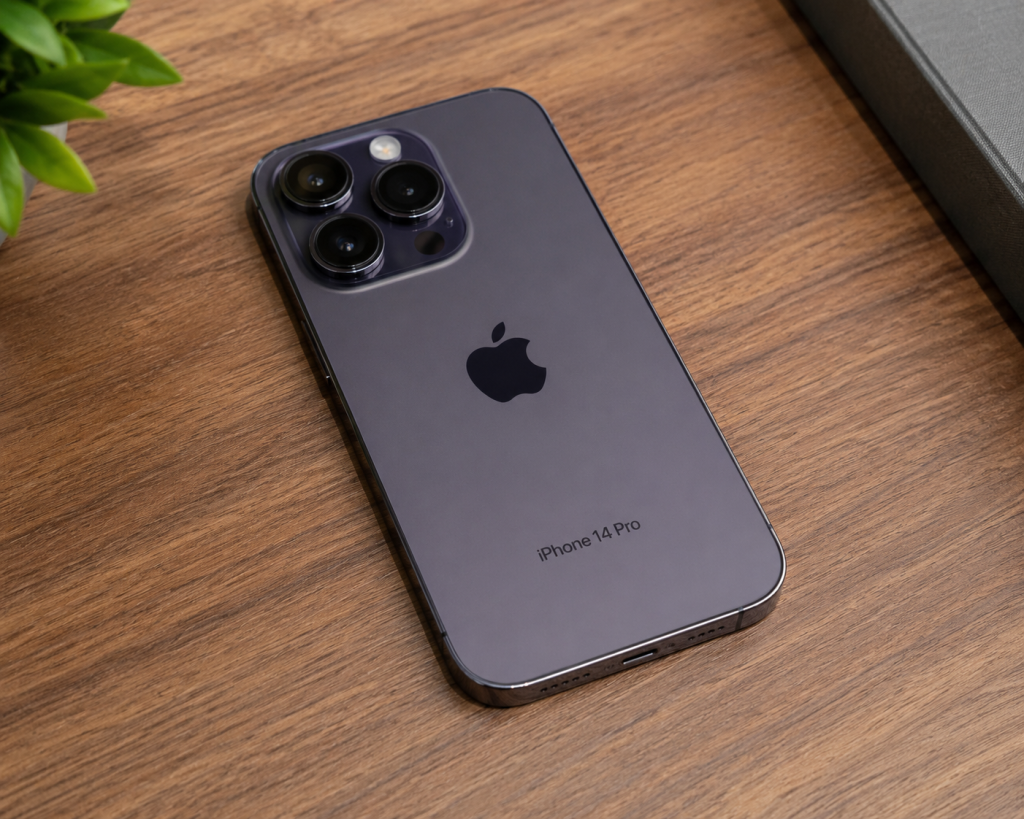
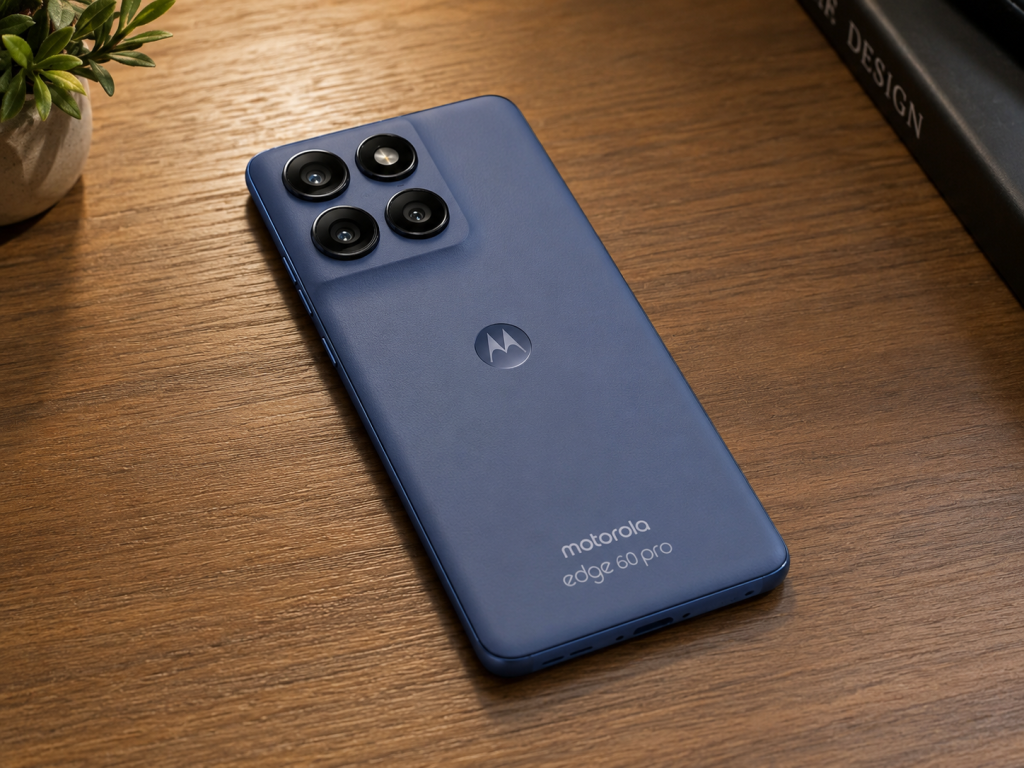
The Edge 60 Pro uses a plastic frame with a glass front protected by Gorilla Glass 7i, and it carries MIL-STD-810H durability certification along with a vegan-leather option on some colorways. It’s a large phone at 6.7 inches and roughly 186 grams, with a curved dual-edge display that gives it a premium look despite the plastic frame.
The iPhone 14 Pro sticks with Apple’s stainless-steel-and-glass sandwich design, which feels denser and more solid in hand but is also heavier and more prone to fingerprints. It’s the more compact of the two at 6.1 inches, so if one-handed use matters to you, the iPhone still has the edge. The Dynamic Island cutout, introduced with this generation, remains one of the more clever pieces of hardware-software design in any phone from this era.
Display Comparison
Both phones use 120Hz OLED panels, but Motorola pushes the numbers further on paper. The Edge 60 Pro’s P-OLED panel supports HDR10+ and reaches up to roughly 4500 nits peak brightness with a sharper 1220×2712 resolution, compared to the iPhone 14 Pro’s lower peak brightness of around 2000 nits and 1179×2556 resolution. In outdoor visibility and raw brightness, the Motorola display generally tests ahead.
That said, the iPhone 14 Pro was the first iPhone with an Always-On Display, and Apple’s color calibration and video codec support (Dolby Vision) remain excellent for consistency across content. For most everyday use, both displays look vibrant and smooth; Motorola simply wins on brightness headroom.
Performance and Processor
The Dimensity 8350 Extreme in the Edge 60 Pro is a capable, efficient upper-mid-range chipset that benchmarks well against 2022-era flagship silicon. The A16 Bionic in the iPhone 14 Pro, despite its age, still holds up impressively in single-core performance thanks to Apple’s tight hardware-software integration — it was Apple’s flagship chip for two consecutive iPhone generations.
In real-world terms: the Edge 60 Pro will generally handle multitasking and newer Android apps more comfortably thanks to more RAM, while the A16 still feels fast in iOS due to how well-optimized the software is. Neither phone will feel underpowered for typical daily use, but the Edge 60 Pro is the newer, more future-proof chipset.
RAM and Storage Options
This category isn’t close. The Edge 60 Pro offers 8GB or 12GB of RAM with 256GB or 512GB of UFS 4.0 storage. The iPhone 14 Pro shipped with just 6GB of RAM, and that number has become a real limitation — it’s the reason the iPhone 14 Pro doesn’t support Apple Intelligence features, since Apple’s on-device AI requires 8GB or more. Storage-wise the iPhone has more tiers (up to 1TB), but you pay a steep premium for the higher-capacity models.
Camera Comparison
Both phones run capable triple-camera systems, but they take different approaches. The Edge 60 Pro’s setup includes a 50MP main sensor (Sony LYT-700C) with OIS, a 50MP ultrawide, and a 10MP telephoto with 3x optical zoom and OIS, plus a 50MP selfie camera with 4K video support.
The iPhone 14 Pro uses a 48MP main sensor with Apple’s Photonic Engine, a 12MP ultrawide, and a 12MP telephoto at 3x zoom, with a 12MP TrueDepth selfie camera. Apple’s computational photography, video stabilization, and color science remain a benchmark in the industry, and ProRAW/ProRes support gives more flexibility to people who edit photos and video seriously. Motorola’s cameras produce punchier, more saturated results out of the box and higher-resolution ultrawide and selfie shots, but Apple generally still leads in video quality and shot-to-shot consistency.
Battery Life and Charging
The Edge 60 Pro wins decisively here. Its 6000mAh battery is nearly double the iPhone 14 Pro’s roughly 3200mAh cell, and it supports 90W wired charging plus wireless and reverse wireless charging — going from empty to a substantial charge in well under an hour. The iPhone 14 Pro tops out around 20-27W wired (with a compatible adapter, sold separately) and 15W MagSafe wireless charging, and its smaller battery means more frequent top-ups, especially as the unit ages and battery health degrades — something worth checking carefully on any used iPhone 14 Pro in 2026.
Software and User Experience
Motorola ships the Edge 60 Pro with a near-stock version of Android (originally Android 15), which most reviewers describe as clean and free of bloatware, with useful Moto-specific gesture shortcuts layered on top. Update support for Motorola phones has historically been shorter than Apple’s or Samsung’s, typically around 3 years of OS upgrades.
The iPhone 14 Pro runs iOS, which still receives full updates in 2026 and is confirmed compatible with recent iOS versions, giving it a longer overall support runway despite its 2022 launch. The tradeoff is that without 8GB+ RAM, it can’t run the full Apple Intelligence suite that newer iPhones offer — you get basic Siri and dictation, but not features like on-device summarization or generative photo editing.
Gaming Performance
The Dimensity 8350 Extreme handles modern mobile games at high settings comfortably and includes a larger vapor chamber for sustained performance during longer sessions. The A16 Bionic, despite its age, remains a strong gaming chip thanks to Apple’s GPU architecture and the tight optimization most iOS games receive. In practice, both phones handle demanding titles well; the Edge 60 Pro may sustain frame rates slightly longer in extended sessions thanks to superior thermals and a much bigger battery buffer.
Audio and Connectivity
The Edge 60 Pro includes stereo speakers with Dolby Atmos, Bluetooth 5.4, Wi-Fi 6, NFC, and dual-SIM/eSIM support. The iPhone 14 Pro offers stereo speakers as well, Bluetooth 5.3, Wi-Fi 6, and NFC, but is eSIM-only in US models with no physical SIM tray. One notable gap: the iPhone 14 Pro still uses Lightning rather than USB-C, which is increasingly inconvenient as more accessories and laptops standardize on USB-C — a disadvantage the Edge 60 Pro doesn’t have.
AI Features and Smart Tools
This is where the RAM gap really shows. The Edge 60 Pro includes Moto AI features like AI-powered image editing, note-taking assistance, and contextual suggestions built on-device and via cloud processing. The iPhone 14 Pro, limited by its 6GB of RAM, cannot run Apple Intelligence — Apple’s generative AI suite is reserved for iPhone 15 Pro and newer. If on-device AI tools matter to you in 2026, the Edge 60 Pro is meaningfully ahead here, and this is arguably the biggest functional gap between the two phones.
Security and Privacy Features
Both phones offer strong baseline security. The Edge 60 Pro uses an in-display optical fingerprint sensor along with face unlock. The iPhone 14 Pro relies on Face ID, which remains one of the most secure and reliable biometric systems available, along with standard iOS features like App Tracking Transparency and Lockdown Mode. Apple also has a long track record of extended security-patch support even after a phone’s mainline OS updates slow down, which is a meaningful advantage for a phone this age.
Price Comparison
The Motorola Edge 60 Pro sells new for roughly $389–$550 depending on region and configuration, with full manufacturer warranty. The iPhone 14 Pro is no longer sold new by Apple; it’s available renewed or refurbished, typically in the $300–$500 range depending on storage and condition, with warranty coverage depending on the seller. Dollar-for-dollar, the Edge 60 Pro gives you more current hardware for similar or less money, but the iPhone 14 Pro’s refurbished pricing gives buyers a way into Apple’s ecosystem and iOS at a discount.
Pros and Cons
Motorola Edge 60 Pro
Pros: Much bigger battery, faster charging, brighter display, more RAM, on-device AI features, USB-C, sold new with warranty.
Cons: Shorter OS update window, plastic frame, less refined camera processing than Apple, brand ecosystem is smaller.
iPhone 14 Pro
Pros: Excellent camera processing and video, Dynamic Island, Always-On Display, Face ID, strong resale value, long iOS support runway, access to Apple’s ecosystem.
Cons: Small battery by 2026 standards, no Apple Intelligence, Lightning port, no longer sold new, battery health is a real concern on used units.
Who Should Buy Motorola Edge 60 Pro?
The Edge 60 Pro fits buyers who want current-generation hardware — big battery, fast charging, high RAM, a bright display, and on-device AI tools — without paying flagship prices, and who don’t mind stepping outside the Apple ecosystem. It’s also a strong pick for anyone prioritizing battery life and charging speed over brand loyalty or camera polish.
Who Should Buy iPhone 14 Pro?
The iPhone 14 Pro makes sense for someone who wants into the Apple ecosystem (iMessage, FaceTime, AirDrop, Apple Watch pairing) at a lower price point, values Apple’s camera and video processing, and doesn’t need on-device generative AI features. It’s best purchased refurbished with verified battery health, since a tired battery is the single biggest risk with any iPhone 14 Pro bought today.
Final Verdict
On paper and in most day-to-day usage, the Motorola Edge 60 Pro is the stronger overall phone in 2026: newer hardware, dramatically better battery life, more RAM, a brighter display, and on-device AI features the iPhone 14 Pro simply can’t run. But the iPhone 14 Pro still holds real advantages in camera/video processing, ecosystem integration, and long-term software support — and its refurbished pricing makes it a legitimate budget entry point into iOS. If you want the best all-around hardware value today, go with the Edge 60 Pro. If you’re specifically after the Apple ecosystem and camera experience at a discount, the iPhone 14 Pro remains a reasonable buy — as long as you check battery health first.
Frequently Asked Questions (FAQs)
Is the Motorola Edge 60 Pro better than the iPhone 14 Pro? For most practical purposes in 2026 — battery life, charging speed, RAM, display brightness, and AI features — yes. The iPhone 14 Pro still leads in camera/video processing and software longevity.
Can the iPhone 14 Pro run Apple Intelligence? No. Apple Intelligence requires at least 8GB of RAM, and the iPhone 14 Pro has 6GB, so it’s excluded from the full feature set.
Does the Motorola Edge 60 Pro support wireless charging? Yes, it supports both wireless and reverse wireless charging in addition to 90W wired charging.
Is the iPhone 14 Pro still receiving software updates in 2026? Yes, Apple continues to support the iPhone 14 Pro with iOS updates, though it’s excluded from Apple Intelligence-specific features.
Which phone has the better camera? It depends on priorities: Motorola’s sensors offer higher resolution and punchier default images, while Apple’s processing generally produces more consistent, natural-looking photos and stronger video quality.
Should I buy a refurbished iPhone 14 Pro in 2026? Only if you verify battery health is 85% or higher and confirm the IMEI isn’t blacklisted — it’s still a capable phone, but battery wear is the main risk on a nearly four-year-old device.