Overview
These two drives aren’t really competing for the same job. The TeamGroup MP44 is a PCIe 4.0 NVMe M.2 SSD built for raw speed inside a desktop or laptop, while the HGST Deskstar NAS 4TB is a 7200 RPM 3.5-inch spinning hard drive built for bulk, always-on storage in a NAS enclosure. Comparing them side by side is really a comparison of two different storage philosophies: speed-per-dollar-per-gigabyte versus capacity-per-dollar-with-durability. This guide breaks down where each one wins.
Quick Comparison Table
| Category | TeamGroup MP44 | HGST Deskstar NAS 4TB |
|---|---|---|
| Type | M.2 2280 NVMe PCIe 4.0 SSD | 3.5″ 7200 RPM SATA HDD |
| Capacities | 512GB–8TB | 4TB (also sold in 3TB/6TB/8TB/10TB variants) |
| Interface | PCIe Gen4x4, NVMe | SATA 6 Gb/s |
| Sequential Speed | Up to ~7,400/6,900 MB/s | ~150–220 MB/s |
| Cache | HMB (uses system RAM) | 64MB or 128MB buffer |
| Warranty | 5-year limited | 3-year limited |
| Noise | Silent (no moving parts) | Audible spin/seek noise |
| Best for | OS drive, gaming, editing, NAS caching | Bulk NAS storage, backups, media libraries |
| Typical Price (4TB) | ~$200 | ~$230 (MSRP) |
Key Specifications
TeamGroup MP44
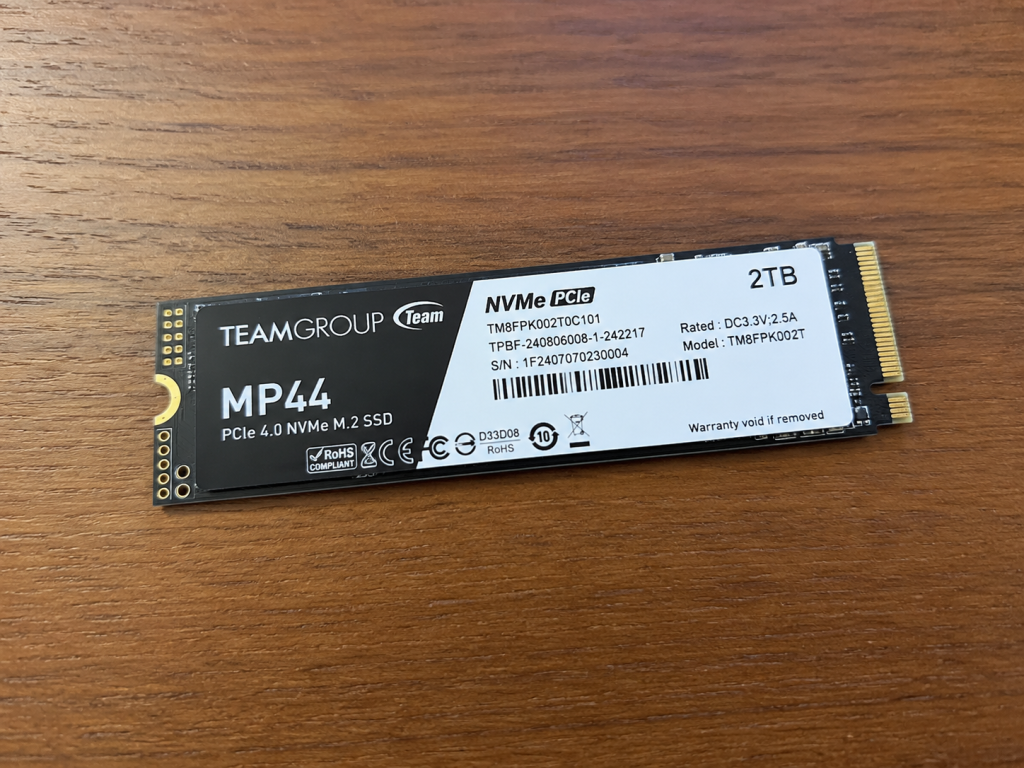
- Form factor: M.2 2280
- Interface: PCIe Gen4x4 NVMe
- Sequential read/write: up to <cite index=”7-1″>7,400/6,900 MB/s for sequential reads and writes with up to 650K/660K random read and write IOPS</cite>
- Capacities: 512GB, 1TB, 2TB, 4TB, 8TB
- Controller: Maxio MAP1602A (232-layer TLC NAND on later units)
- TBW endurance: <cite index=”9-1″>700TBW for the 512GB, 1,450TBW for the 1TB, 2,500TBW for the 2TB, 3,000TBW for the 4TB, and 6,000TBW for the 8TB</cite>
- Warranty: 5 years
HGST Deskstar NAS 4TB
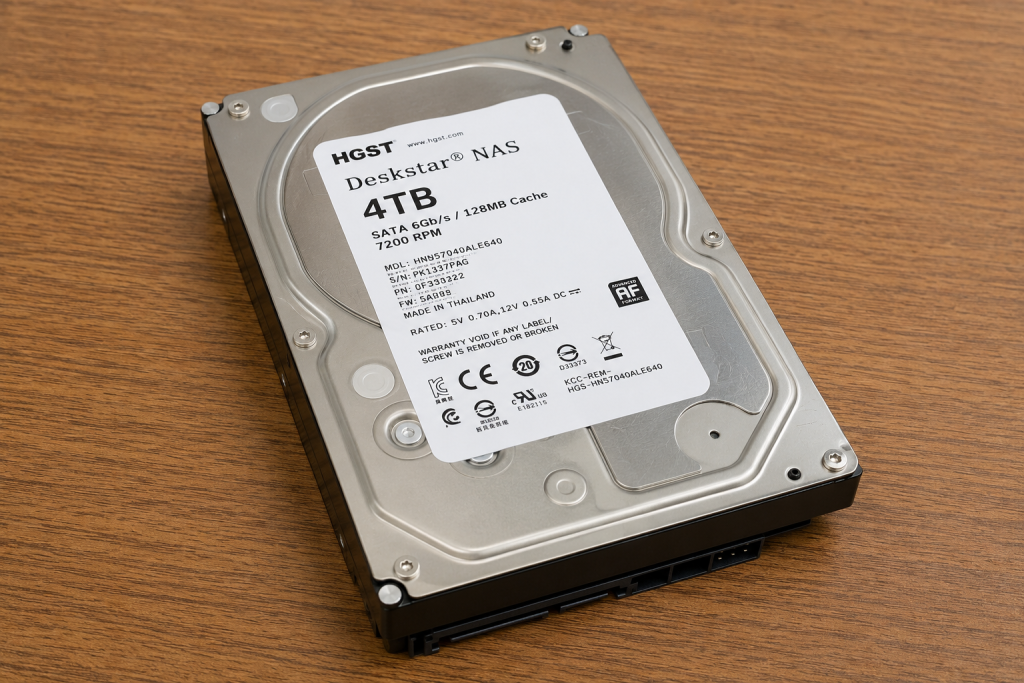
- Form factor: 3.5-inch internal drive
- Interface: SATA 6 Gb/s
- Rotational speed: <cite index=”12-1″>7,200 RPM with a 64MB data buffer, media transfer rate up to 1,638 Mbits/s, and interface transfer rate up to 600 MB/s</cite> (later revisions ship with a 128MB cache)
- Areal density: <cite index=”15-1″>446 Gbits per square inch</cite>
- Reliability: <cite index=”11-1″>rated for 1 million hours MTBF and includes a rotational vibration sensor</cite>
- Idle power draw: <cite index=”15-1″>around 6.9 watts</cite>
- Warranty: 3 years
Design and Build Quality
The MP44 is a tiny circuit board about the size of a stick of gum, protected by a thin graphene heat-spreading label rather than a bulky heatsink, which keeps it compatible with slim laptops and small-form-factor builds. The Deskstar NAS, by contrast, is a full-size 3.5-inch drive with spinning platters and a mechanical actuator arm, built more like a small precision machine than a chip. It includes vibration sensors to keep the heads stable when multiple drives are stacked together in a multi-bay NAS chassis.
Performance
There’s no contest on raw throughput. The MP44 pushes sequential speeds roughly 30-40 times faster than the Deskstar NAS, and its random I/O performance (hundreds of thousands of IOPS) is not something a mechanical drive can approach at all, since HDDs are fundamentally limited by how fast the platters spin and the heads seek. Where the Deskstar can hold its own is in raw sustained sequential throughput for large, continuous file transfers common in media libraries and backup jobs — it’s just working at HDD-class speeds, not SSD-class ones.
Storage Capacity and Speed
The MP44 ranges from 512GB up to 8TB, giving buyers flexibility to match capacity to budget and workload. The Deskstar NAS line tops out higher, with capacities eventually reaching 10TB in the same product family, better suited to bulk archival needs where cost-per-terabyte matters more than access speed. For pure speed, though, capacity for capacity, the SSD wins every time.
Reliability and Durability
This is where the trade-offs flip. SSDs like the MP44 have no moving parts, so they resist physical shock and vibration extremely well, but their lifespan is measured in total bytes written (TBW) — heavy, continuous writes over years can wear out the flash cells. The Deskstar NAS is rated for continuous 24/7 operation and carries a 1-million-hour MTBF rating with vibration compensation for multi-drive arrays, but as a mechanical device it’s inherently more vulnerable to physical shocks, drops, and the eventual wear of moving parts. For pure archival redundancy in a NAS array, HDDs like this one remain the traditional choice; for a system drive that takes a beating from constant read/write cycles without physical stress, the SSD is more resilient in daily use.
Power Consumption
The MP44 sips power, especially at idle, since flash memory doesn’t need to keep anything spinning. The Deskstar NAS draws meaningfully more, with idle consumption around 6.9 watts per drive and higher spikes on startup — multiply that across a 4-8 bay NAS enclosure and it adds up compared to lower-RPM NAS drives, let alone an SSD.
Noise and Heat Levels
The MP44 is completely silent; its only “heat” consideration is a light aluminum/graphene label to help dissipate the heat NVMe drives generate under sustained load. The Deskstar NAS, spinning at 7200 RPM, is noticeably audible — drive spin and seek clicks are common complaints in quiet home offices, and it also runs warmer than lower-RPM NAS-class drives.
Compatibility
The MP44 requires a free M.2 slot that supports PCIe Gen4x4 NVMe; older motherboards or laptops without that slot type simply can’t use it. The Deskstar NAS uses a standard SATA connection, which is compatible with almost any desktop, external enclosure, or NAS unit built in the last decade — it’s the more universally droppable-in option.
Real-World Use Cases
- MP44: Operating system boot drive, video editing scratch disk, game library drive, or as a fast cache tier in front of a NAS.
- Deskstar NAS 4TB: Bulk file server storage, media server libraries (Plex, Jellyfin), backup targets, surveillance/DVR storage, and multi-bay NAS arrays where capacity and 24/7 reliability matter more than speed.
Pros and Cons
TeamGroup MP44
- Pros: Extremely fast sequential and random performance; silent; low power draw; 5-year warranty; wide capacity range
- Cons: Higher cost per terabyte; TBW-limited lifespan under heavy sustained writes; needs a compatible PCIe 4.0 M.2 slot
HGST Deskstar NAS 4TB
- Pros: Purpose-built for 24/7 NAS duty; vibration sensor for multi-drive arrays; broad compatibility via SATA; strong price-per-terabyte for bulk storage
- Cons: Much slower than any SSD; audible noise; higher power draw than lower-RPM NAS drives; mechanical parts mean vulnerability to shock; shorter 3-year warranty
Price and Value for Money
At the time of release, MP44 capacities were priced <cite index=”9-1″>around $58 for 1TB, $110 for 2TB, $267 for 4TB, and $820 for 8TB</cite>, making the 4TB tier the strongest value point in the lineup. The Deskstar NAS 4TB carried an <cite index=”15-1″>MSRP of $229.99</cite>. Judged purely on dollars per gigabyte for bulk storage, the HDD is typically cheaper; judged on dollars per unit of performance, the SSD is the clear winner.
Who Should Buy the TeamGroup MP44?
Choose the MP44 if you want a fast boot/OS drive, need quick load times for games or large creative files, or want a speedy cache layer sitting in front of slower bulk storage. It’s the right pick for anyone prioritizing responsiveness over raw capacity-per-dollar.
Who Should Buy the HGST Deskstar NAS 4TB?
Choose the Deskstar NAS if you’re building or expanding a home or small-business NAS, need a large media or backup library, or run a multi-bay array where continuous uptime and capacity matter more than speed. It’s built for exactly this always-on, mechanical-workhorse role.
Frequently Asked Questions (FAQ)
Can I use the MP44 in a NAS? Some NAS units with M.2 NVMe slots support it as a cache drive, but it isn’t designed to be the primary bulk-storage drive of a multi-bay array the way the Deskstar NAS is.
Is the HGST Deskstar NAS still a good buy today? It performs well for its era and RPM class, but newer NAS-specific HDDs from Western Digital (Red Plus/Pro) and Seagate (IronWolf) have since become more common go-to options; availability of the Deskstar NAS line may be limited today.
Which lasts longer, an SSD or an HDD? It depends on use case. SSDs like the MP44 fail based on total data written over time; HDDs like the Deskstar NAS fail based on mechanical wear and operating hours. Neither is universally “longer lasting” — it’s workload-dependent.
Do I need both types of drive? Many home server setups actually use both: an NVMe SSD for the OS/cache and mechanical HDDs for bulk storage, which is exactly the kind of pairing these two drives were designed for.
Final Verdict
There’s no single winner here because these drives aren’t solving the same problem. If speed, responsiveness, and silence matter most, the TeamGroup MP44 is the better drive by a wide margin. If your priority is maximizing storage capacity for the lowest cost per terabyte in a 24/7 NAS environment, the HGST Deskstar NAS 4TB is the more appropriate tool. In many real-world builds, the best answer is to use both — MP44 for speed, Deskstar NAS for capacity — rather than picking one over the other.